
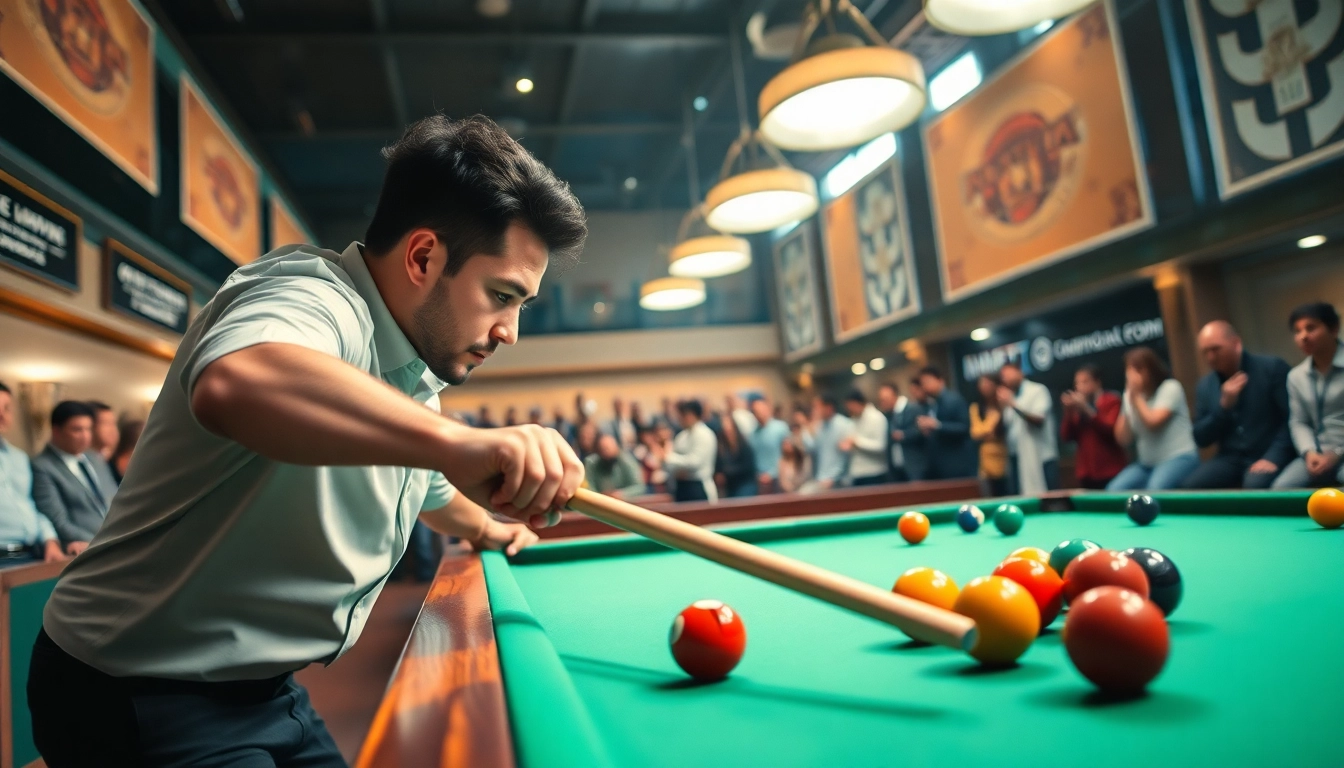
Understanding the Basics of Billiards
What is Billiards?
Billiards is a cue sport played on a rectangular table covered with cloth, where players use a cue stick to strike balls. Unlike games like pool, which generally involve pockets, billiards can refer to multiple variations that typically do not include any. The overarching concept of billiards encapsulates different game types, including carom and straight rail, each with unique rules and objectives, splendidly showcasing skill and precision.
The Essential Equipment for Billiards
To enjoy Billiards, you need some essential equipment. A quality cue stick, typically made from wood, is paramount for effective play. The balls themselves differ depending on the game variant but usually consist of three main types: cue ball, object balls, and in some cases, a red ball. A billiards table, often larger than a pool table, is usually 9 to 12 feet long and has no pockets. Additionally, a solid chalk for the cue tip and other accessories like a bridge stick and a rack enhance your playing experience.
Basic Rules and Scoring in Billiards
The rules in Billiards can vary based on the type of game being played, yet there are fundamental principles that remain constant. In a typical carom game, players score points by hitting the cue ball to contact both the opponent's ball and the red ball. The object is to maximize points per turn while adhering to the game's strategic demands. Additionally, understanding fouls and their consequences is crucial, as committing one can disrupt your game's flow and provide opportunities for your opponent.
Techniques to Improve Your Billiards Game
Perfecting Your Stance and Grip
A solid foundation begins with the stance. Your feet should be shoulder-width apart, providing a stable base while allowing for fluid movement. The grip on your cue should be light—think of holding a bird; you want to keep control without strangling it. Adjusting your grip based on your shot type—whether it’s a long-range shot or a delicate one—can significantly impact your accuracy and control.
Aiming Techniques for Accuracy in Billiards
Aiming accurately involves not merely pointing your cue but visualizing the trajectory of your ball. Use the ghost ball technique: imagine where the cue ball will go to contact the object ball and keep your focus on that contact point. Additionally, a consistent pre-shot routine builds confidence and enhances precision, allowing you to settle into each hit with mental clarity.
Practicing Your Stroke Consistency
To maintain an effective stroke, start from a comfortable and uniform position for every shot. Practice drills that focus solely on your stroke mechanics. For example, doing straight strokes and using a corner pocket to focus your follow-through can reinforce muscle memory. Regularly recording your sessions can help identify areas needing improvement.
Advanced Billiards Strategies
Understanding English and Spin
English refers to the effects applied to the cue ball that cause it to spin, influencing its path after contact. Understanding how to apply top, back, and side spin allows you to navigate the table better and control the cue ball's trajectory. Practicing these spins on various shots will build your competency and improve your strategic gameplay.
Reading the Table: Angles and Positioning
Effective billiards players can accurately read the table, understanding how angles influence movement. Practicing angle visualization helps predict the path of not only your cue ball but all involved balls. Positioning plays a crucial role; aim to place your cue ball in favorable spots for the subsequent shot, ensuring a continuous game flow and strategic advantage.
Developing Defensive Play in Billiards
Defensive play is essential when you can’t make a challenging shot. Consider how to place the enemy balls so that your opponent has a harder next shot. Executing a safety play—where the object ball is obstructed or positioned in a way that makes a direct shot difficult—enhances your tactical options and can create openings for scoring.
Participating in Billiards Tournaments
Preparing for Your First Tournament
Participating in your first billiards tournament can be daunting. Preparation is key. Familiarize yourself with tournament rules and formats, practice consistently, and consider developing a game plan for each match. Attend a few matches as a spectator to observe skilled players and learn from their strategies while building your confidence in the competitive atmosphere.
Understanding Tournament Formats and Rules
Tournaments can vary significantly in their format—some may use a single elimination process, while others might be round-robin style. Familiarize yourself with the specific rules, including match play and point scoring. Being well-versed will not only boost your confidence but will also help you strategize effectively during matches.
How to Deal with Competition Stress in Billiards
Experiencing competition stress is normal, but dealing with it effectively is essential. Techniques such as deep breathing, visualization, and mental rehearsal can help calm nerves. Creating a preshot routine, focusing momentarily on the table, and eliminating extraneous thoughts keeps concentration sharp and enhances overall performance.
Frequently Asked Questions About Billiards
How can I practice billiards at home?
Practicing billiards at home includes setting up a table and utilizing drills to elevate your skills. Concentrate on shot consistency, aim precision, and strategic positioning to enhance your overall performance.
What are the differences between billiards and pool?
Billiards generally denotes games played on a table without pockets, while pool games take place on tables featuring six pockets. The distinction extends to rules and gameplay dynamics, often requiring different skill sets.
Are there different types of billiards games?
Yes! Various billiards games, including Carom and Straight Rail, come with different rules and objectives. Each can challenge players' skills uniquely, providing diverse playing experiences.
What should I look for in a billiards table?
Choosing a billiards table entails considering factors like size, material, felt type, and cushion quality. These aspects play a significant role in enhancing your gaming experience and enjoyment.
Can I compete in billiards as a beginner?
Indeed! Many local tournaments welcome beginners to encourage participation. Starting in smaller competitions allows you to gain crucial experience and build confidence in your game style.
For detailed guides, tips, and resources on improving your skills in Billiards, consider regularly visiting dedicated billiards platforms or joining local clubs to immerse yourself fully in the community and sport.
Contact Information
Call Us: +1 615-624-7821Email: [email protected]Address: 1276 Northwest Broad Street, Murfreesboro, TN 37129, USA